Judith A. Shinogle Memorial Fellowship

Tanya Kreutzer Sayyed (2025)
Renato DiPentima Fellowship

Melanie Hardy (Spring 2026)
Melanie Hardy is pursuing a Ph.D. in the Urban Policy track within UMBC’s School of Public Policy and is an acquisition professional supporting the U.S. Navy. She holds a Master’s degree in Sociology, and her research interests lie at the intersection of housing policy, redevelopment, and economic mobility.
In addition to her doctoral studies, Melanie teaches sociology and is passionate about educating the next generation of scholars. Her professional and academic experiences have shaped her interest in community development, neighborhood revitalization, and redevelopment policy. She hopes her research will contribute to ongoing conversations about how neighborhood revitalization policies are evaluated.

Liran Laor (Spring 2025)
Liran Laor is a public policy doctoral student at University of Maryland, Baltimore County (UMBC). Her research focuses on child care issues, including workforce, professional associations and leadership. In addition, Liran is a program manager at Montgomery County Early Childhood Services, overseeing special projects related to the child care workforce. Finally, Liran was a fellow at the National Early Care and Education Workforce Center; an article about her fellowship research project was recently accepted for publication at the Discover Education journal.

Grace De Oro (Fall 2023)
Grace De Oro is a Ph.D. Candidate on the Public Management track in the School of Public Policy. Grace’s research is focused on nonprofit resilience through an organizational management lens. Currently she is working on a case study about emergency management nonprofits’ experience during the COVID-19 Pandemic as well as what resilience looks like in their organization. Grace is also the Graduate Student Association President for the FY 2023-2024 school year. The fellowship provides Grace the financial means to attend the 2023 ARNOVA Annual Conference where she has been invited to present her case study titled, Bouncing Forward: Exploring Nonprofit Resilience during COVID-19 through Emergency Management.
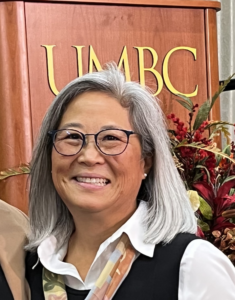
Margaret Kaii-Ziegler (Fall 2023)
Margaret Kaii-Ziegler is a Ph.D. Candidate in the Public Management track working with Dr. Edwards. Her dissertation is titled, The Role of Value Alignment in Collaborative Governance: A Case Study of a Metropolitan Planning Organization. Her work proposes a new methodology to evaluate the effectiveness of a regional governance body and identifies underlying factors that can inhibit true collaboration leading to innovation. She has a B.S. in Landscape Architecture, a Master or Regional Community Planning, and 30+ years of experience working in government.
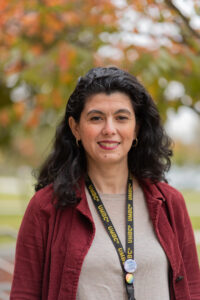
Doha Chibani (Spring 2023)
Doha is a mental health clinician and a Ph.D. Candidate within the Health Policy track. Her research explores Federal and State policies that regulate insurance coverage for behavioral health and the role they play in access to care, especially for the economically disenfranchised and people with marginalized identities. Doha currently runs a joint UMB-UMBC SAMHSA grant funded research and training clinic providing early identification and intervention services to youth and young adults at risk of developing serious mental illness.

Jennifer Walsh (Spring 2023)
Jennifer Walsh is a UMBC School of Public Policy (Health Policy track) Ph.D. candidate pursuing her dream of completing her degree program. Her dissertation is focused on the Opioid Epidemic, particularly how Naloxone distribution programs are implemented in Maryland. She believes her research will be impactful in helping those programs target the populations who are most at risk of opioid overdoses and equipping them with the appropriate Naloxone intervention more effectively. With a Mental Health background, she serves as the Senior Disability Coordinator in the Accessibility and Disability Services office at Towson University.
Adam Yarmolinsky Fellowship

Linda Appaynarh (2026)
I am a Ph.D. student in Public Policy at the University of Maryland, Baltimore County, where I serve as a Graduate Assistant in the School of Public Policy and conduct research through the InnoTech Policy Lab. My work connects technology, inequality, education, and development, with current research focused on misinformation and election integrity in the era of artificial intelligence, election cybersecurity and voter turnout, and AI-powered mobile money and disaster resilience in sub-Saharan Africa. Building on earlier research examining how telecommunications liberalization and education shape jobs and inequality in Ghana and other developing contexts, I study how digital systems, cyber threats, institutional design, and the digital divide can either widen or reduce disparities in opportunity. The Adam Yarmolinsky Fellowship supports my research on how digital and institutional reforms can strengthen democratic participation, improve access to public benefits, reduce inequality, and promote inclusive growth, and this work will help inform my dissertation.
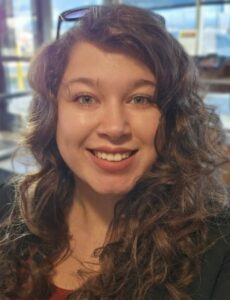
Marly Milić (2024)
Marly is a native Baltimorean, daughter of immigrants, and very proud, future double alumna of UMBC. In 2020, she earned her bachelor’s degree in political science and is now pursuing her MPP. She works for the Maryland General Assembly as a chief of staff for a state delegate. Marly takes her work in political advocacy very seriously and is particularly passionate about transportation and housing policy. In her free time, Marly is an amateur seamstress and carpenter and a loving dog mom to her faithful pup, Sammy.
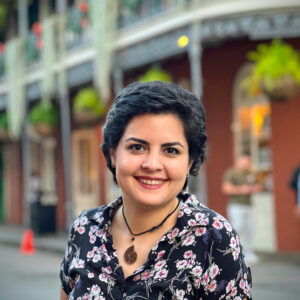
Shadi Seyedi Khabbaz (2024)
Shadi Seyedi is a Ph.D. student with a specialization in Evaluation and Analytical Methods. Shadi holds a B.S. degree in economics from Ferdowsi University in Iran and an M.S. degree in Applied Economics and Econometrics from the University of Delaware. Additionally, Shadi serves as a graduate assistant, collaborating closely with Dr. Bennett on their research.
Shadi’s primary passion lies at the intersection of health policy evaluation, where they explore the causal effects of health policies by integrating advanced econometrics and machine learning methods for comprehensive evaluation. They are driven by their dedication to researching and promoting positive change in healthcare outcomes and access to quality care for vulnerable, marginalized, and underserved communities.
Inspired by their experience with U.S. health services as an immigrant, Shadi’s current research project examines how Medicaid expansion under the ACA influences the health and healthcare access of foreign-born individuals in the United States.
Judy Yin Shih Fellowship
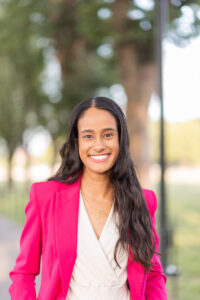
Smitha Prabhu (2025)
Smitha is a Graduate Assistant at the Hilltop Institute and a Ph.D. Candidate within the Health Policy track. Smitha graduated from Johns Hopkins University with a B.A. in Philosophy and a Minor in Bioethics and worked with community organizations in Baltimore for at least seven years, including the Baltimore City Health Department, International Rescue Committee, and Baltimore Harm Reduction Coalition.
Her education and work experience inspire her research interest in harm reduction, maternal and child health policy, and equitable public policy. Her dissertation research explores providers’ perspectives and the impact of surveillance practices on the quality of care provided to families affected by substance use disorders.
Smitha currently works for the Aging and Disability team at the Hilltop Institute, where she conducts policy analysis and program evaluation to advance innovative service delivery for older adults and people with chronic conditions and disabilities.
Doha Chibani (2024)
Doha is a mental health clinician and a Ph.D. Candidate within the Health Policy track. Her research explores Federal and State policies that regulate insurance coverage for behavioral health and the role they play in access to care, especially for the economically disenfranchised and people with marginalized identities. Doha currently runs a joint UMB-UMBC SAMHSA grant funded research and training clinic providing early identification and intervention services to youth and young adults at risk of developing serious mental illness.
These student fellowships are supported by our generous donors.
You can also support all Public Policy Fellowships to help outstanding public policy students pursue their graduate studies.
Learn more on our Giving and Awards page.