Vision
Emerging technologies—especially artificial intelligence (AI) and quantum computing—are rapidly reshaping cybersecurity, governance, and the functioning of democratic institutions. These transformations often advance faster than policy research and institutional preparedness, creating critical knowledge gaps that undermine organizational resilience and public trust. The InnoTech Policy Lab confronts these challenges through rigorous, interdisciplinary research that evaluates, informs, and shapes cybersecurity policy frameworks for the next generation of technological innovation. Through this work, the Lab positions UMBC as a national leader at the intersection of emerging technologies, cybersecurity, and public policy.
Core Purposes and Objectives
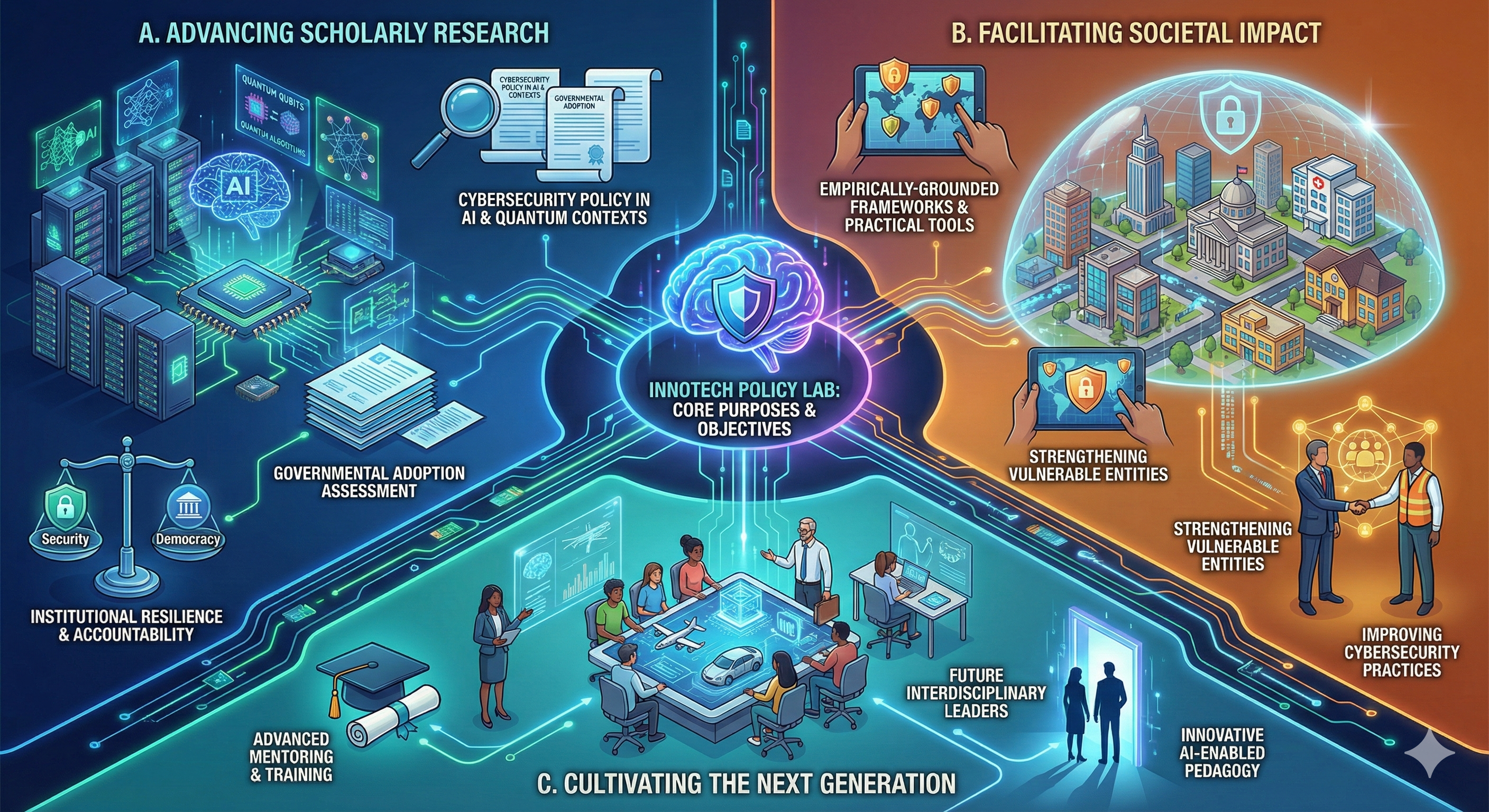
The Lab pursues three overarching purposes, each supported by specific research and educational goals centered on the cybersecurity implications of emerging technologies.
A. Advancing Cutting-Edge Scholarly Research
- Conduct high-quality, interdisciplinary research on cybersecurity policy in the contexts of AI, quantum computing, and other emerging technologies.
- Critically evaluate how governments adopt, integrate, and govern advanced technological systems to enhance cybersecurity, strengthen national and organizational resilience, improve institutional performance, and safeguard democratic accountability.
- Develop conceptual, empirical, and data-driven frameworks that deepen scholarly understanding of evolving cybersecurity risks and policy responses.
B. Facilitating Significant Societal Impact
- Create empirically grounded assessment tools, indices, and decision-support systems that improve cybersecurity readiness for vulnerable public-sector and nonprofit institutions.
- Examine how emerging technologies alter governance structures, stakeholder relationships, and public trust, offering actionable recommendations to practitioners and policymakers.
- Translate complex research findings into accessible, evidence-based insights that support stronger cybersecurity practices at the local, state, and national levels.
C. Cultivating the Next Generation of Cybersecurity Policy Scholars and Professionals
- Provide advanced mentoring, research training, and professional development for graduate research assistants, preparing future leaders in cybersecurity policy and emerging technology governance.
- Design and deliver innovative educational programs on cybersecurity policy related to AI, quantum computing, unmanned aerial systems, and electric vehicles.
- Advance research on AI-enabled teaching and learning methods to enhance the effectiveness and accessibility of cybersecurity and technology policy education.